
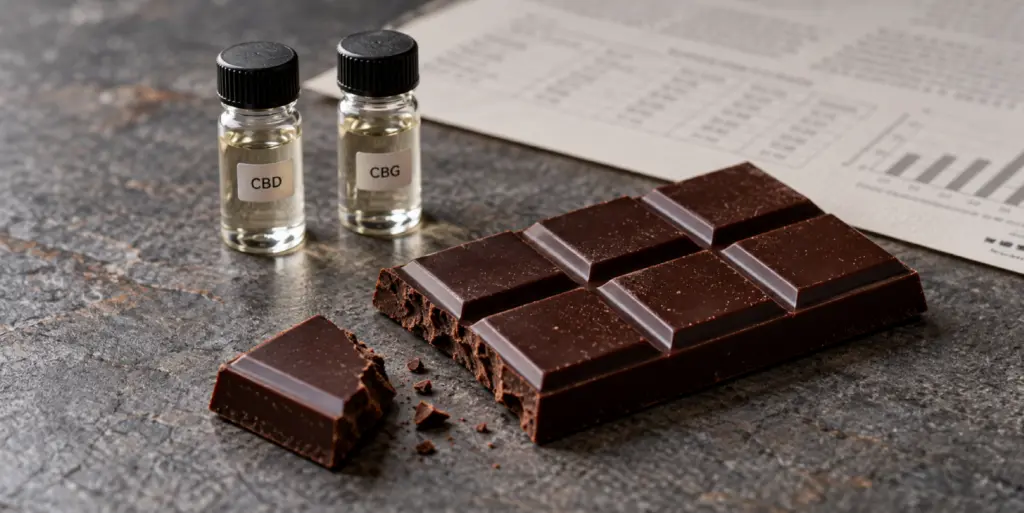
CBG vs CBD is becoming an increasingly relevant comparison as cannabis consumers explore cannabinoids beyond THC. Although both compounds occur naturally in cannabis, they have different chemical structures, research histories, and potential biological interactions.
Understanding these differences matters when evaluating functional cannabis edibles. Rather than focusing exclusively on THC concentration, consumers can examine the complete cannabinoid profile and supporting ingredients.
At Jersey Canna, this approach is reflected in chocolates that incorporate CBG, CBD, and other selected ingredients. However, understanding the scientific evidence is essential before associating specific cannabinoids with particular effects.
CBG vs CBD: Understanding the Fundamental Differences
CBG, or cannabigerol, and CBD, or cannabidiol, are naturally occurring cannabinoids found in the cannabis plant.
Unlike THC, neither is generally associated with producing the characteristic intoxicating cannabis high. Nevertheless, they interact with biological systems differently.
CBD has received substantial scientific attention, particularly through research involving neurological conditions and prescription medications.
CBG has a smaller clinical research base, although interest in its potential biological properties continues to grow.
The distinction is important because two cannabinoids should not be considered interchangeable simply because both are generally described as non-intoxicating.
How CBG and CBD Originate in the Cannabis Plant
Cannabinoid development begins with chemical processes occurring naturally within cannabis.
One important compound is cannabigerolic acid, or CBGA.
CBGA acts as a precursor in the biosynthesis of several major cannabinoid acids, including THCA and CBDA. These compounds can later become THC and CBD through decarboxylation.
CBG is the neutral cannabinoid associated with CBGA after decarboxylation.
A scientific review published in Synthetic Biology explains the central role of CBGA in cannabinoid production.
This biological relationship helps explain why CBG is often associated with early cannabinoid development. However, CBGA—not CBG itself—is the principal natural precursor in these pathways.
CBG vs CBD Effects: What Does Scientific Research Actually Support?
The research surrounding these cannabinoids is developing at different rates.
CBD: More Extensive Clinical Research
CBD has been investigated across multiple medical and pharmacological studies.
The FDA has approved Epidiolex, a prescription medicine containing purified CBD, for certain severe seizure disorders.
According to the FDA’s cannabis research and drug approval guidance, this approval applies to a specific pharmaceutical product and its studied medical uses.
It does not establish that ordinary CBD edibles can treat neurological conditions, anxiety, sleep problems, or other diseases.
CBG: Emerging Evidence and Important Limitations
CBG research remains at an earlier stage.
A 2024 randomized, placebo-controlled clinical study examined the short-term effects of 20mg CBG in 34 healthy adults.
Researchers observed reductions in self-reported anxiety and stress under certain study conditions.
However, the study involved a relatively small sample and measured acute responses. These findings do not establish CBG as an approved treatment or demonstrate the effects of CBG-containing chocolate.
Larger clinical trials are necessary to understand its potential benefits, appropriate doses, and long-term safety.
Can CBD or CBG Change the Effects of THC?
Cannabinoid combinations add another layer of complexity.
CBD is sometimes described as a compound that automatically reduces THC’s intoxicating effects. However, scientific findings are more nuanced.
Research summarized by the National Institutes of Health found that high oral doses of CBD combined with THC increased certain drug effects compared with THC alone.
The study used substantially higher CBD amounts than those found in many standard edibles. Its findings should not be generalized to every THC-and-CBD product.
This reinforces an important principle: adding CBD or CBG to THC does not guarantee a particular experience.
Dose, formulation, metabolism, and individual sensitivity remain relevant.
Why CBG and CBD Appear in Functional Cannabis Edibles
Functional cannabis edibles incorporate cannabinoids alongside other selected ingredients to create differentiated product formulations.
Some include vitamins or caffeine. Others feature botanical ingredients or multiple cannabinoids.
The term functional describes the product’s formulation and positioning. It does not necessarily indicate clinically demonstrated health benefits.
Jersey Canna’s functional cannabis edibles collection provides examples of how manufacturers develop different products using cannabinoid combinations.
Product Spotlight: The CannaJolt Energy Bar™ and CBG
The CannaJolt Energy Bar™ is a functional cannabis chocolate featuring CBG.
Category: Functional Cannabis Edible / THC Chocolate Bar
Its formulation includes:
- 5mg THC per piece
- 20 pieces per bar, totaling 100mg THC
- CBG
- Caffeine
- Vitamin B12
- Sativa terpenes
- Dark chocolate
CannaJolt demonstrates how CBG can be incorporated into a broader, multi-ingredient cannabis chocolate.
Its energy-oriented positioning reflects the complete formulation, including caffeine. It should not be interpreted as proof that CBG independently improves energy or concentration.
Consumers should review the package for precise ingredient amounts and serving information.
Product Spotlight: Love & Romance Sensuals™ and CBD
Love & Romance Sensuals™ offers a different example of functional cannabis chocolate.
Category: Functional Cannabis Edible / THC + CBD Chocolate
Each piece contains:
- 10mg THC
- 10mg CBD
- Belgian chocolate
- A botanical blend containing Maca, Horny Goat Weed, Ginseng, L-Arginine, and Theobromine
The package contains 10 pieces, providing 100mg THC and 100mg CBD in total.
This creates a 1:1 THC-to-CBD ratio, distinguishing it from CBG-containing CannaJolt.
Love & Romance Sensuals™ illustrates how CBD can be combined with THC and botanical ingredients in a sensory-focused chocolate.
However, the formulation does not establish guaranteed improvements in relaxation, intimacy, or physical performance.
Reading Cannabinoid Labels Beyond THC
Understanding CBG vs CBD can help consumers evaluate cannabinoid-rich products more carefully.
An informative product label should help consumers identify the cannabinoid content, serving size, and other ingredients.
When comparing functional edibles, it is useful to consider whether the product contains THC, CBD, CBG, or a combination.
Consumers should also distinguish the amount per serving from the total package potency.
The FDA warns that CBD can cause side effects and interact with certain medications.
Additionally, cannabis products containing THC may impair attention, coordination, and judgment.
The New Jersey Cannabis Regulatory Commission recommends starting with a low amount of THC, waiting for the full effects, and purchasing from licensed dispensaries.
Adults should avoid driving after consuming cannabis and keep all edibles securely stored away from children and pets.
CBG vs CBD: Understanding Their Role in Modern Cannabis Chocolate
CBG and CBD represent two distinct cannabinoids with different scientific histories and emerging applications.
CBD has a more established clinical research foundation, including an FDA-approved prescription medication. CBG continues to attract research interest, although evidence from large human studies remains limited.
For functional cannabis edibles, their inclusion creates opportunities for different product formulations. However, ingredient combinations should never be confused with guaranteed therapeutic outcomes.
Jersey Canna demonstrates this diversity through CBG-containing CannaJolt™ and THC-and-CBD Love & Romance Sensuals™.
For adults 21 and older in New Jersey, explore Jersey Canna and its functional cannabis edibles collection to learn more about cannabinoid-rich chocolates and available product formulations.