
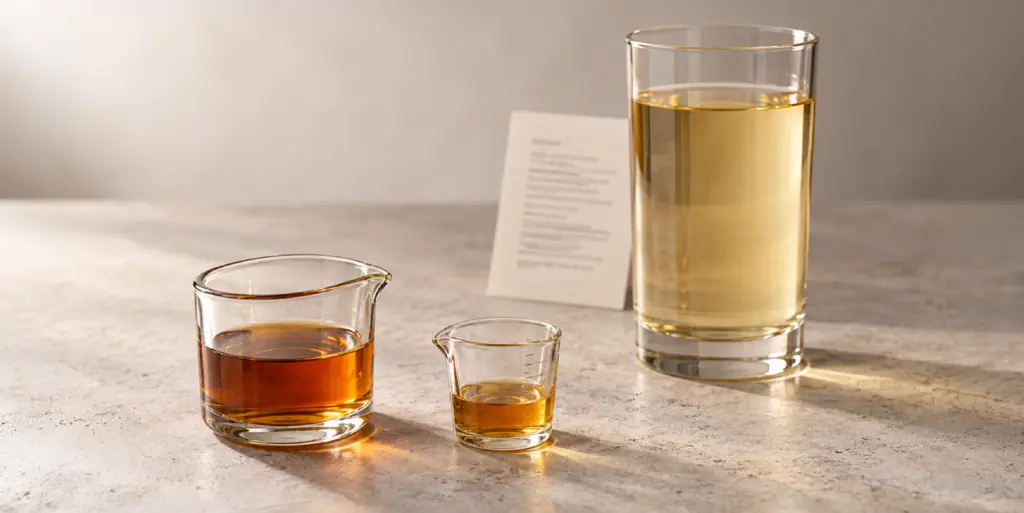
THC syrup introduces a different approach to cannabis edibles. Unlike a ready-to-drink cannabis beverage, syrup is a concentrated liquid formulation that requires careful attention to cannabinoid distribution, serving size, and ingredient composition.
These differences extend beyond flavor or packaging. They affect how manufacturers design products and how consumers interpret their labels.
At Jersey Canna, liquid cannabis edibles include products such as CannaJolt™ Syrup and Wind Down™ Syrup. Both demonstrate how cannabis syrups can combine THC with additional ingredients while maintaining distinct product identities.
THC Syrup vs. Cannabis Drinks: What Is the Difference?
The main difference lies in how the product is presented and portioned.
A ready-to-drink cannabis beverage generally comes as a prepared liquid with a defined THC concentration. Consumers receive the finished beverage without needing to measure a concentrated syrup.
THC syrup, meanwhile, is designed as a concentrated liquid edible. Its formulation and labeled serving instructions determine how much THC is contained in an individual portion.
This distinction matters because the total THC content of a bottle is not necessarily the amount contained in one serving.
In New Jersey, the Cannabis Regulatory Commission’s guidance for ingestible products recognizes syrups and single-serve beverages as separate authorized formats.
Understanding these differences helps consumers interpret liquid edible products more accurately.
What Makes THC Syrup Formulation So Complex?
One of the greatest challenges in developing liquid cannabis edibles involves cannabinoid solubility.
THC is naturally lipophilic, meaning it associates more readily with fats and oils than with water. This creates technical challenges when manufacturers develop water-based liquid products.
Why Cannabinoid Distribution Matters
Depending on the formula, manufacturers may use emulsification technologies or other approaches to distribute cannabis ingredients throughout a liquid.
These systems must maintain consistency during manufacturing and storage.
A peer-reviewed study on cannabis oral emulsions found that formulation differences influenced physical stability and cannabinoid uniformity. Some experimental formulations experienced phase separation during storage.
This highlights why liquid edible development requires attention to stability and homogeneous cannabinoid distribution.
However, a syrup’s appearance alone cannot confirm its potency or manufacturing quality. Those characteristics require appropriate product-specific testing.
Why Measured Servings Matter in THC Syrup
Liquid edibles create a distinct serving-size challenge.
A segmented chocolate bar has visible individual pieces. Syrup depends on the volume of liquid associated with each labeled serving.
Consequently, accurate serving information and proper measuring instructions are essential.
For example, a bottle containing 100mg THC does not necessarily represent a single serving.
The consumer must review the product label to determine the intended portion and THC concentration.
This is particularly important because liquid appearance, flavor, and viscosity cannot reliably indicate cannabinoid potency.
Product Spotlight: Jersey Canna’s Functional THC Syrups
Jersey Canna’s cannabis beverages collection features two syrup formulations with distinct ingredients and product concepts.
CannaJolt™ Syrup: A Cannabis and Caffeine Formulation
CannaJolt™ Syrup is a lemonade-flavored cannabis syrup developed around an energy-oriented product concept.
Category: Liquid Cannabis Edible / Functional THC Syrup
Its listed characteristics include:
- 10mg THC and 20mg caffeine per serving
- 100mg THC and 200mg caffeine per 90ml bottle
- Sativa cannabis extract
- Vitamins B3 and B12
- Sugar-free, fat-free, gluten-free, and vegan-friendly formulation
CannaJolt demonstrates how manufacturers can combine cannabis with caffeine, vitamins, and flavor ingredients.
However, its energy-focused positioning should not be interpreted as proof of improved concentration or performance. Cannabis may impair attention and coordination, and combining it with stimulants introduces additional considerations.
Wind Down™ Syrup: A Different Cannabinoid Combination
Wind Down™ Syrup represents another approach to functional liquid edibles.
Category: Liquid Cannabis Edible / Functional THC Syrup
The product features mixed berry flavor, Indica cannabis extract, CBN, and additional nutraceutical ingredients.
Unlike CannaJolt, Wind Down is positioned around an evening-oriented experience.
Its formula illustrates how cannabinoid selection and supporting ingredients can distinguish two products within the same edible format.
Nevertheless, its positioning does not establish guaranteed relaxation or sleep benefits. Individual responses can differ, and product claims should be evaluated against available evidence.
Why Ingredients Matter Beyond THC
THC concentration provides important information, but it does not describe the complete liquid edible.
Additional cannabinoids, caffeine, flavoring ingredients, sweeteners, and vitamins can all influence the product’s composition.
Consumers should review the complete ingredient list rather than making decisions based only on THC potency or marketing descriptions.
The New Jersey Cannabis Regulatory Commission’s responsible consumption guidance also warns that combining cannabis with alcohol, medications, or stimulants can increase impairment or other risks.
For that reason, ingredient transparency is especially important in functional cannabis products.
Does THC Syrup Work Faster Than Other Cannabis Edibles?
A liquid format does not automatically guarantee faster effects.
How quickly cannabis takes effect can depend on the formulation, amount consumed, individual metabolism, and method of administration.
The CDC’s guidance on cannabis edibles explains that ingestible cannabis products may take approximately 30 minutes to two hours to produce noticeable intoxicating effects.
Effects can also last longer than anticipated.
Consumers should therefore avoid assuming that a syrup will act immediately because it is liquid.
The safest approach is to follow labeled instructions, begin with a low amount, and wait before consuming additional THC.
Packaging, Storage, and Responsible Liquid Edible Use
Liquid cannabis edibles require appropriate packaging and storage.
New Jersey’s ingestible cannabis guidance specifies that multi-serving liquid products need resealable closures. Packaging must also meet applicable child-resistant and labeling requirements.
Adults should use the manufacturer’s measuring instructions rather than estimating servings with an ordinary spoon or bottle cap.
Storage instructions matter as well. For example, Jersey Canna advises consumers to shake Wind Down™ Syrup before use and refrigerate it after opening.
Always follow the specific label, avoid driving after consuming THC, and keep cannabis products securely away from children and pets.
Exploring THC Syrup in New Jersey
THC syrup demonstrates how cannabis edibles can evolve beyond traditional chocolates and gummies.
Its development involves cannabinoid distribution, liquid stability, serving accuracy, flavor formulation, and ingredient selection.
CannaJolt™ and Wind Down™ illustrate two different concepts within this emerging format. Both show why evaluating the complete ingredient list is more informative than comparing THC numbers alone.
For adults 21 and older interested in learning more, explore Jersey Canna and its liquid cannabis edibles collection.
You can also use the Jersey Canna Where to Buy locator to find participating licensed dispensaries in New Jersey and verify current product availability.